Category: News

  • DAYSTAR UNIVERSITY WINS KES 17.5 MILLION NATIONAL CHILD LABOUR STUDY GRANT

    DAYSTAR UNIVERSITY WINS KES 17.5 MILLION NATIONAL CHILD LABOUR STUDY GRANT

    By Tracy Kavai,


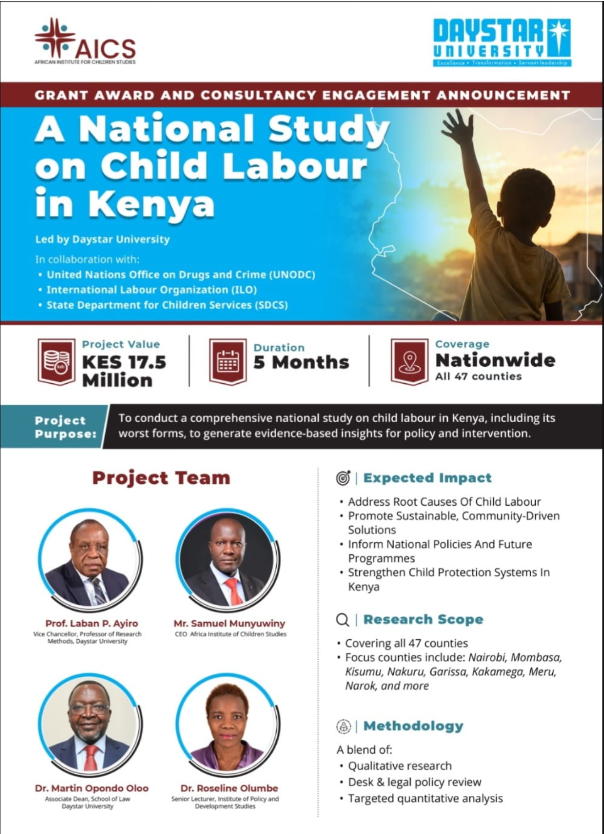
    Daystar University has secured a landmark national research grant and consultancy engagement worth KES 17.5 million to implement a nationwide study on child labour in Kenya.

    The announcement was made by the Directorate of Research, Innovation, Commercialization, and Entrepreneurship (DRICE), describing the achievement as a major milestone for the university’s growing reputation in impactful and policy-driven research.

    The five-month study will cover all 47 counties in Kenya and aims to generate evidence that will help inform public policy, strengthen child protection systems, and guide future interventions aimed at combating child labour and its worst forms.

    The research project will be conducted in collaboration with the United Nations Office on Drugs and Crime, the International Labour Organization, and the State Department for Children Services. The partnership highlights Daystar University’s increasing recognition as a trusted institution in national and international research engagements.

    DRICE congratulated the project team led by Prof. Laban P. Ayiro, Vice-Chancellor and Professor of Research Methods at Daystar University. Other members of the team include Dr. Martin Opondo Oloo, Dr. Roseline Olumbe, and Samuel Munyuwiny, who is also a Daystar PhD student and adjunct lecturer.

    According to DRICE, the achievement reflects the power of visionary leadership, multidisciplinary scholarship, doctoral talent, and strategic collaboration in addressing pressing national challenges affecting children in Kenya.

    The Directorate further noted that the project aligns with Daystar University’s commitment to advancing justice, influencing public policy, and transforming society through meaningful research and innovation.


    In a statement signed by Dr. Caroline Ayuya Muaka, the university community was encouraged to celebrate the milestone and congratulate the research team for bringing pride and recognition to Daystar University.



  • PETRO DOLLAR

    PETRO DOLLAR

    By Joe Aura, aurajoe6@gmail.com


    The term petrodollar refers to US dollars paid to oil-exporting countries for petroleum. This system, established in the 1970s, has been a cornerstone of US global financial dominance, by ensuring high demand for the dollar.


    How the System Works

    • The Pact: In 1974, the US and Saudi Arabia struck a deal where the Saudis would price their oil exclusively in dollars and invest their surpluses into US Treasury securities.
    • Military Protection: In exchange, the US provided military protection and advanced weaponry to the Gulf states.
    • Petrodollar Recycling: Exporters “recycle” these dollars by investing them back into US assets or buying foreign goods, which helps fund US budget deficits and keeps interest rates low.

    Impact on Global Finance

    The Petrodollar system acts as a “price amplifier” for the world. Because countries with little or no oil reserves must first buy Dollars to then buy oil. Any change in the value of the Dollar or the price of oil hits your pocket twice.

    In Kenya, fuel prices are heavily influenced by the USD/KES exchange rate. Since oil is traded in Petrodollars, Kenya’s fuel import bill (which accounts for nearly 15% of all imports) must be settled in USD. When the Shilling weakens against the Dollar, the cost of importing fuel rises even if global oil prices stay the same. As of April 29, 2026, the exchange rate is approximately KSh 129.10 per USD. This relatively high rate, combined with a 41.5% to 68.7% spike in global landed costs due to Middle East tensions, forced fuel prices to record highs this month.

    Transport fares in Kenya respond almost instantly to fuel price changes because fuel typically represents about 55% of a vehicle’s total operating costs. Following the mid-April price hike—where Diesel jumped by KSh 40.30 per liter—the Matatu Owners Association and other transporters announced immediate fare increases.

    The recent increase in these costs is primarily driven by a historic spike in fuel prices and new regulatory levies, which have created a “ripple effect” across the entire Kenyan economy. When the cost of moving people and goods rises, it immediately pushes up the price of everything else, from bus fares to the food on your plate.

    Online cab services (like Uber/Bolt) have had to strategise on how to implement a 1.5x fare multiplier to cope with these record-high costs. Ironically, even electric bus operators in Nairobi have raised fares recently, citing the broader inflationary pressure caused by the high cost of the Dollar-denominated energy market.

    For story pitches, commissioned writing, or collaborations, connect with Joe on LinkedIn:
    https://www.linkedin.com/in/aura-joe-digitalproducer/recent-activity/articles/

  • LIGHTING IN KENYA, THUNDER ABROAD – NCT DOMINANCE CHALLENGED

    LIGHTING IN KENYA, THUNDER ABROAD – NCT DOMINANCE CHALLENGED

    By Joe Aura, aurajoe6@gmail.com


    As Kenya’s most dominant basketball side, Nairobi City Thunder has rewritten local history with an 82-game unbeaten streak and back-to-back KBF Premier League titles.


    They dominate, often blowing out opponents by over 30 points often emulating the phrase ‘When Thunder Roars, Go Indoors’

    However, as their Basketball Africa League (BAL) journey shows, African competition is a different battlefield altogether.

    Thunder’s BAL debut in 2025 was a reality check. They finished 1–5, struggling against established powerhouses like Al Ahly Tripoli and APR.

    In 2026 A narrow loss to Tanzania’s Dar City and a bounce-back win over Johannesburg Giants highlight a team still finding its footing at the highest level. Having watched a Thunder vs. Thunders exhibition match at Nyayo Stadium, the gap isn’t talent; it is experience, structure, and exposure.

    The challenge begins off the court.

    Thunder have invested in a professional structure that many Kenyan teams still lack. Through sponsorships, branding and better player support, the club has created an environment that allows athletes to perform at a higher level. This includes partnerships with companies like Flutterwave and M-KOPA and a focus on fan experience that makes the team culturally relevant.

    This approach shows that success in modern sport is not accidental but built through planning and investment. Moreover, if NCT or any other teams are to compete in BAL, we need to up the local competition.

    Marcel Awori, who works behind the scenes with the club, explains this clearly. In his interview with GQ, he notes that the talent and passion have always been present in African basketball, but what has been missing is consistent investment and structure. His view reflects the situation in Kenya where players are capable, but systems are still catching up.

    This explains why Thunder can dominate locally but struggle to fully impose themselves in Africa.

    The issue therefore goes beyond one team. Kenyan basketball still faces challenges in infrastructure, governance and professional organization. Many clubs operate without strong financial backing or long-term planning. Facilities are limited and expensive to maintain. Player development pathways are not fully structured, and integration of diaspora talent remains inconsistent. These factors make it difficult for teams to compete at the same level as well-funded African clubs.

    Improving results requires fixing the system, not just the squad.

    Despite these challenges, the support from Kenyan fans continues to grow. At The Beer District, supporters gather to watch Thunder’s BAL matches together. The atmosphere reflects belief in the team and excitement about basketball’s future in the country.

    Fans wearing Thunder merchandise even receive a free beer which adds to the experience and keeps the connection between the team and its supporters strong. This shows that the culture around basketball is growing even if results are still catching up.

    The question now is whether Kenya will build on this model. If more teams adopt professional structures, invest in players and improve organization, the gap with the rest of Africa can close. If not, Thunder may remain an exception rather than the beginning of a movement.

    As fans prepare for the next BAL clash against Al Ahly Ly, Kenya are starting to understand what it will take to even think about qualification.

    For story pitches, commissioned writing, or collaborations, connect with Joe on LinkedIn:
    https://www.linkedin.com/in/aura-joe-digitalproducer/recent-activity/articles/

  • A Battle for Control?

    A Battle for Control?

    By Chelangat Caren,

    In a shocking turn of events, Nairobi Hospital, Kenya’s premier medical institution, has found itself at the center of a heated controversy involving President William Ruto. The dispute, which began as an internal governance issue, has escalated into a full-blown scandal, with accusations of government interference and attempts to take over the hospital.

    It all started when a group of senior doctors at Nairobi Hospital approached President Ruto, alleging mismanagement and corruption within the hospital’s administration. The doctors claimed that the hospital’s board was involved in shady dealings, including manipulation of the members’ register and embezzlement of funds .

    In response, President Ruto vowed to protect the hospital from “conmen and fraudsters,” stating that he would not allow it to be taken over by individuals seeking personal gain. The President’s intervention led to the arrest of several hospital officials, including the board chairman, Dr. Job Obwaka, on charges of conflict of interest and financial reporting violations .

    However, the hospital’s management has denied any wrongdoing, claiming that the government’s actions are an attempt to take control of the institution. Dr. Barcley Onyambu, the board chairperson, stated that the hospital is stable and operational, and that the current public friction is a result of governance issues, not institutional failure.

    The controversy has sparked outrage among Kenyans, with some accusing the government of trying to silence critics and take over private institutions. Opposition leaders, including Justin Muturi, have condemned the government’s actions, stating that they are an attempt to intimidate medical professionals .

    The implications of this drama are far-reaching. If the government succeeds in taking over Nairobi Hospital, it could set a worrying precedent for private institutions in Kenya. The move could be seen as an attempt to stifle dissent and consolidate power, undermining the country’s democratic gains.

    As the drama continues to unfold, Kenyans are left wondering what the future holds for the hospital and the country’s institutions. Will the government succeed in its bid to take control, or will the hospital’s management emerge victorious? The fate of Nairobi Hospital hangs in the balance, and the nation is watching closely.

    The Nairobi Hospital saga is a test of Kenya’s institutions and the rule of law. Will the government respect the autonomy of private institutions, or will it use its power to crush dissent? One thing is certain – the outcome will have far-reaching implications for Kenya’s future.


  • Ninety Minutes, Two Months, and One Appeal Later

    Ninety Minutes, Two Months, and One Appeal Later

    Story by Richard Onyango,

    It was supposed to be over.

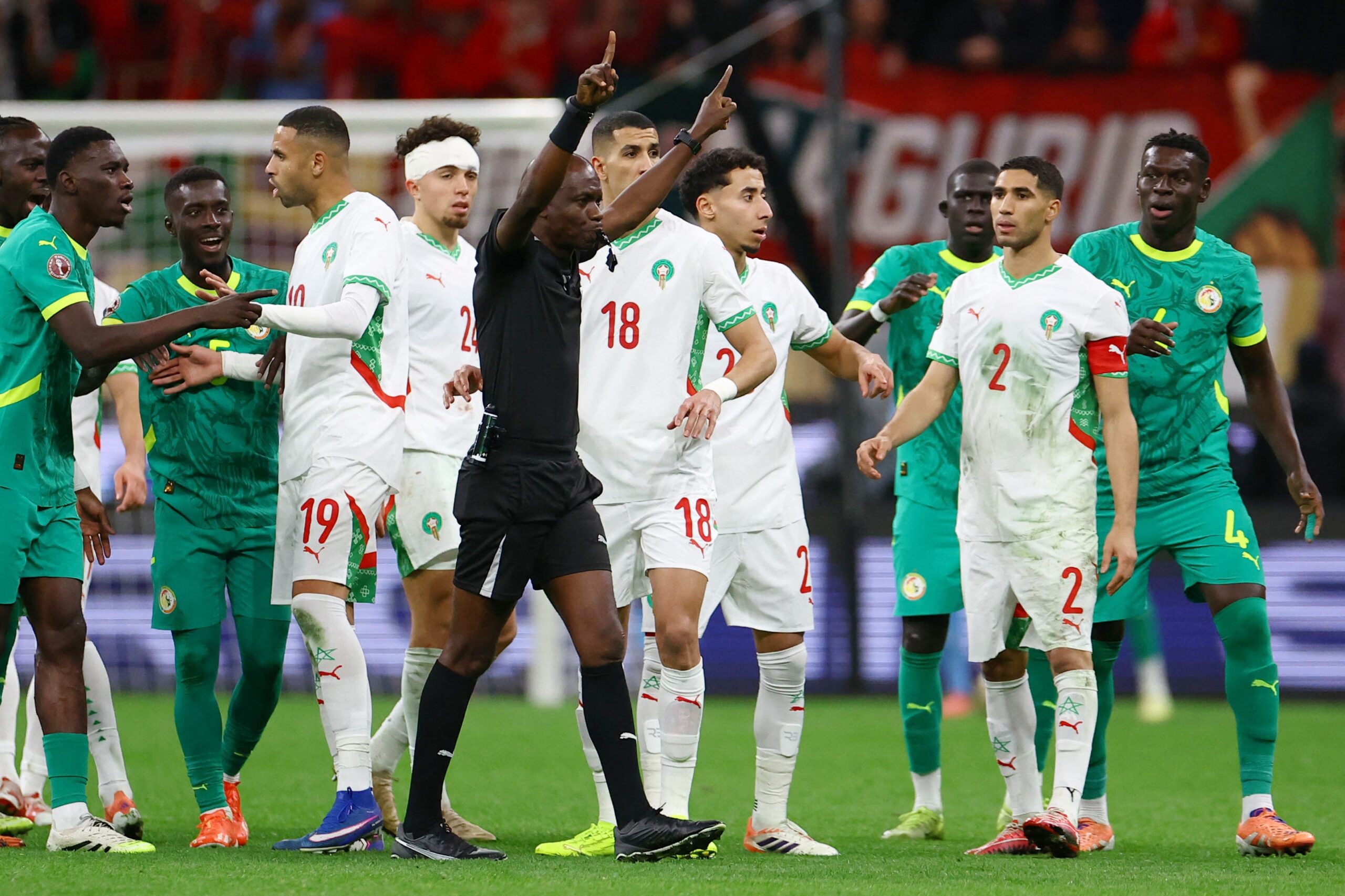
    The final whistle had already blown, the stadium in Dakar had already erupted, and Senegal had already written its name into the golden pages of African football history. Flags waved like restless oceans, drums echoed into the night, and a nation danced with the kind of joy that only football can deliver. The trophy had been lifted, kissed, and carried through the streets like a sacred symbol of triumph.

    And yet, somewhere between the confetti settling and the celebrations fading into memory, a question began to form, quiet at first, almost insignificant. Then it became impossible to ignore. What if the story was not over?

    Weeks passed, and then months and what had once felt like a sealed chapter began to reopen. Documents surfaced, appeals were filed, and conversations shifted from celebration to scrutiny. Morocco, a team that had walked the long road to the final only to fall short, was suddenly backed in the spotlight. Not on the pitch this time, but in boardrooms, in hearings, in the cold, procedural world where football meets law.

    The claim was bold. The implications were even bolder. Could a match already played be undone? Could a winner already crowned be questioned? Could history itself be rewritten? As the days stretched on, the continent watched. Fans argued in barbershops and buses, on timelines and talk shows. Some laughed it off, dismissing it as impossible. Others leaned in, drawn by the sheer audacity of it all. Because football, as it turns out, is not always decided in ninety minutes.

    And then, the unthinkable happened, after weeks of tension and months of waiting, Morocco was declared the rightful winner. Not through goals scored on grass, but through rulings delivered across polished tables. The announcement did not come with roaring crowds or flares lighting the sky. It came quietly, almost clinically. But its impact was anything but quiet.

    Senegal, the champions of the night, suddenly found themselves in a strange and surreal position. Victors, but no longer recognized as such. Celebrations that had once felt eternal now felt suspended in time, like a dream that someone had abruptly interrupted.

    What about Morocco? Their victory arrived not with the rush of adrenaline, but with the weight of controversy. A title won, yes, but wrapped in questions that refused to settle. So what now becomes of a trophy already lifted? Does it change hands like a misplaced artifact? Does it carry two stories, two truths, depending on who tells it? And what of the medals, the prize money, the memories etched into the hearts of players and fans alike?

    Do you return joy once it has already been lived?

    Do you rewrite history once it has already been celebrated?

    And perhaps the most unsettling question of all, who really won?

    Because in the end, football is more than decisions and declarations. It is emotion, it is moments, and it is the sound of a nation believing all at once. And those things, once created, are not so easily taken away. Not in ninety minutes. Not in two months. Not even after one final appeal.

  • DAYSTAR UNIVERSITY HOSTS DIPLOMATIC DAY ON BLUE ECONOMY AND MARITIME SECURITY AND DIPLOMACY

    DAYSTAR UNIVERSITY HOSTS DIPLOMATIC DAY ON BLUE ECONOMY AND MARITIME SECURITY AND DIPLOMACY

    By Tracy Kavai

    ATHI RIVER, KENYA – On Wednesday, March 11, 2026, Daystar University’s Athi River campus became a global stage for maritime and diplomatic discourse as the School of Arts and Social Sciences hosted its annual Diplomatic Day.

    The high-level summit, themed Shared Perspectives on Blue Economy, Maritime Security, and Diplomacy,” brought together a formidable assembly of regional power players, international envoys, and ambassadors from the ASEAN region to bridge the gap between academic theory and the urgent geopolitical needs of the Indian Ocean rim.

    The event moderated by Dr. Radoli Ouma Radoli, PhD, Associate Dean of the School of Communication, kicked off with a vibrant performance by the Daystar University Choir and a solemn prayer session led by University Chaplain Rev. Miano Weche, who urged attendees to “take reconciliation into the world and become ambassadors of peace.”

    Dr. Radoli took a central role in welcoming a high-profile delegation that included Mr. Joseph Boinnet representing Ambassador Monica Juma, Director-General of the United Nations Office on Drugs and Crime at Vienna, Ambassador Nancy Karigithu (representing CS Hassan Joho), and Mr. Mustafa Ibrahim (representing PS Dr. Abraham Korir Sing’oei). The international diplomatic corps was strongly represented by H.E. Witjaksono Adji (Indonesia), H.E. Marie Charlotte G. Tang (Philippines), H.E. Ruzaimi Mohamad (Malaysia), Ms. Ruvini De Silva (Sri Lanka), and Ms. Piyaporn Putanapan (Thailand). Also in attendance were Lieutenant Colonel Ernest Ndirangu of the Kenya Naval Training College, Dr. Solomon Njenga of the Mashariki Research and Policy Centre, and Mr. Paul Kariuki of the ICRC.

    Opening the official speaking program, the Dean of the School of Arts and Social Sciences, Dr. Josephine Munyao, welcomed the guests by emphasizing the pedagogical mission of the day. She stated, “The goal of this annual event is to link classroom learning and real-life experiences. We are looking forward to learning a lot, and by the end of this day, we will be very rich.”

    Following the Dean, the Deputy Vice Chancellor for Academic Research and Student Affairs, Prof. Samuel Muriithi, grounded the economic discussion in ethical responsibility, noting that “God gave humanity responsibility over the earth. Let us be good stewards of creation and the ocean economy,” while calling for firm legislation to protect the environment.

    The security of the continent’s waters was then addressed by Mr. Joseph Boinnet, the former Inspector General of Police, who delivered a message on behalf of Ambassador Monica Juma. Mr. Boinnet cautioned that economic growth is impossible without safety, stating, “We need to safeguard sea lines of communication, protect offshore infrastructure, and create stability within which trade and livelihoods can flourish.” This was followed by Mr. Mustafa Ibrahim, who noted that “diplomacy today extends beyond traditional state-to-state relations and now incorporates the blue economy to prevent systemic weaknesses in governance.” Lieutenant Colonel Ernest Ndirangu then explained the military’s role, stating that the “Kenya Navy turns maritime strategy into diplomacy, securing the ocean and building partnerships.”

    Representing the policy frontier, Ambassador Nancy Karigithu delivered a powerful charge on behalf of CS Hassan Joho, declaring, “The real blue economy is not a political concept, it’s not a slogan, but a tangible, measurable, governable resource base that Kenya is only beginning to unlock.”

    The international community then provided a global blueprint for cooperation, led by H.E. Witjaksono Adji, who described the Indian Ocean as a “bridge connecting Africa and Asia.” He was supported by H.E. Marie Charlotte G. Tang, who remarked that “advancing maritime rights is a shared responsibility,” and H.E. Ruzaimi Mohamad, who highlighted Malaysia’s model of safe maritime activities. Ms. Ruvini De Silva and Ms. Piyaporn Putanapan both concluded that diplomacy remains the primary tool to ensure the Indian Ocean remains a zone of peace.

    The technical and humanitarian complexities were rounded off by expert perspectives from Dr. Solomon Njenga, who detailed the “Climate-Security-Peace nexus,” and Mr. Paul Kariuki, who reminded the summit that humanitarian protection must remain at the heart of all maritime policies.

    The event concluded with cultural networking and a tree-planting ceremony, reaffirming Daystar University’s mission to shape future global citizens through excellence and servant leadership.


  • DAYSTAR HOSTS FINANCIAL LITERACY FORUM

    DAYSTAR HOSTS FINANCIAL LITERACY FORUM

    By Tracy Kavai

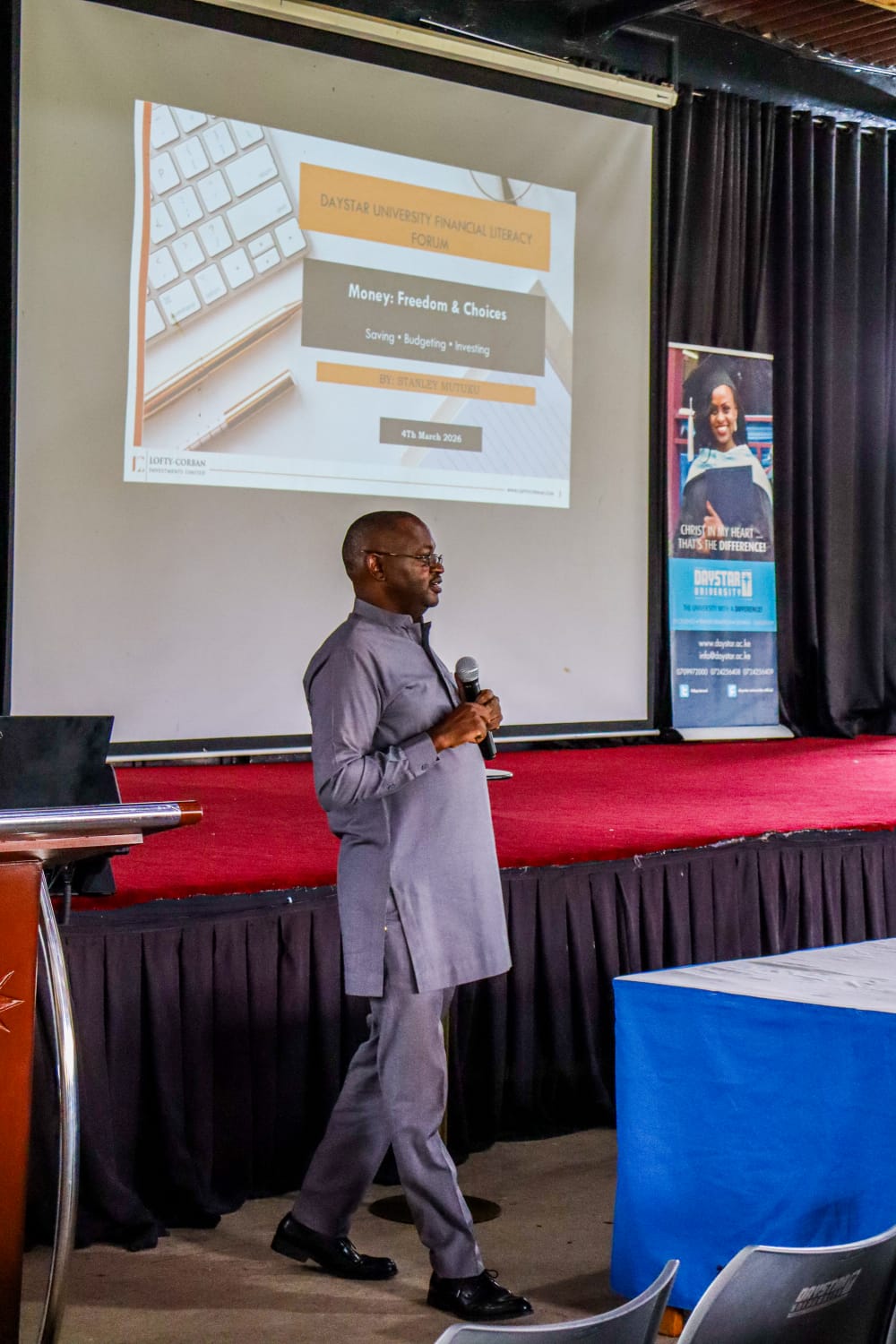
    The Daystar University Students Association (DUSA) hosted a Financial Literacy Forum under the theme “Money, Freedom and Choices” on Wednesday, March 4, 2026, at the Main Campus Amphitheatre in Athi River. The event, which ran from 10:00 a.m. to 4:00 p.m., attracted a vibrant turnout from students across the university community.

    The forum brought together experts from the Institute of Certified Public Accountants of Kenya (ICPAK), the National Treasury of Kenya, ICEA Lion Group, and CIC Asset Management to unpack critical issues around personal finance, including budgeting, savings, and investments.

    Delivering the keynote address, CPA Stanley Mutua, CEO of Lofty‑Corban Investments, spoke on the theme “Money, Freedom and Choices.” He reminded students that money is more than currency, describing it as a tool that provides independence, stability, solvency, and peace of mind.

    “Most financial stress comes from the lack of a simple plan. Begin with savings, build an emergency fund, and then invest wisely. Debt is the fastest way to lose freedom, pay off expensive loans first, then invest consistently,” he said.

    Mutua also challenged students to adopt a 7‑Day Financial Action Plan to take immediate control of their finances. The plan encourages students to write a budget separating needs, wants, and goals; identify and eliminate at least two spending leaks; open or activate a savings or money market fund; set up automatic weekly transfers; learn one investing concept such as inflation, compounding, or risk; explore a side‑income idea based on their skills; and review their progress over 30 days.

    He further simplified investing by linking traditional asset classes to practical student realities: preservation through savings and money market funds, income through bonds and dividends, growth through equities and balanced funds, and longevity through diversified, long-term investments.

    Also contributing to the forum, Aguyah Wilfred Aguya, a Financial Advisor at the ICEA Lion Group, emphasized the importance of discipline and consistency in investing. He encouraged students to avoid debt-driven investments, diversify their portfolios, and focus on long-term compounding strategies to build wealth.

    Elizabeth Mureithi, Wealth Advisor at CIC Asset Management, urged students to recognize and develop their God-given talents and skills as a foundation for financial independence. She highlighted those personal abilities, whether academic, creative, or entrepreneurial, can be nurtured into sustainable income streams and long-term opportunities.

    DUSA Treasurer Purity Wangui reinforced the importance of financial literacy, noting that the forum aimed to equip students with practical life skills beyond the classroom.

    “We want Daystar students to leave here not only with academic knowledge but also with the ability to make smart financial choices that shape their future,” she said.

    The event offered more than just learning. Attendees enjoyed refreshments, free Red Bull cans, and transport arranged for students traveling from the Valley Road campus.

    The forum was made possible through the support of sponsors including the Daystar School of Business & Economics, ICPAK, ICEA Lion Group, CIC Asset Management, Red Bull, and Zhele V3/Shelev X3. Their partnership highlighted the importance of empowering young people with financial knowledge and practical skills.

    By the end of the forum, students left inspired to take greater control of their financial futures through informed decision-making, disciplined saving and investing, and responsible financial leadership.

  • GLAMOUR AND MYSTERY AWAIT AT DAYSTAR’S STAR OF EXCELLENCE AWARDS

    GLAMOUR AND MYSTERY AWAIT AT DAYSTAR’S STAR OF EXCELLENCE AWARDS

    By Tracy Kavai,

    Daystar University is preparing for an evening of glamour and celebration as the community gears up for the highly anticipated Star of Excellence Awards—2026 Edition.

    The event is scheduled for Saturday, April 11, 2026, and will feature a captivating Masquerade theme.

    Organized by the Daystar University Students’ Association (DUSA), the awards ceremony will recognize outstanding students and groups whose leadership, creativity, and service have made a significant impact on campus life.

    The event will highlight achievements ranging from academic excellence to community engagement, reflecting Daystar’s core values of Excellence, Transformation, and Servant Leadership.

    DUSA Secretary-General Jerry Amimo George Ambuche (JAGA) described the ceremony as more than an awards night, noting that it is designed to celebrate the talent and dedication within the Daystar community while encouraging students to participate fully in the themed experience.

    Attendees can look forward to a vibrant masquerade atmosphere, red-carpet moments, live performances, and the excitement of seeing peers honored for their accomplishments. The mask-themed concept is expected to add a unique blend of mystery and elegance to the evening.

    As anticipation continues to build, the Star of Excellence Awards is shaping up to be one of the semester’s standout events, bringing together recognition, creativity, and celebration in true Daystar fashion.


  • DAYSTAR’S INTERNATIONAL STUDENTS’ ASSOCIATION TO HOST 16TH DIPLOMATIC DINNER

    DAYSTAR’S INTERNATIONAL STUDENTS’ ASSOCIATION TO HOST 16TH DIPLOMATIC DINNER

    By Tracy Kavai,

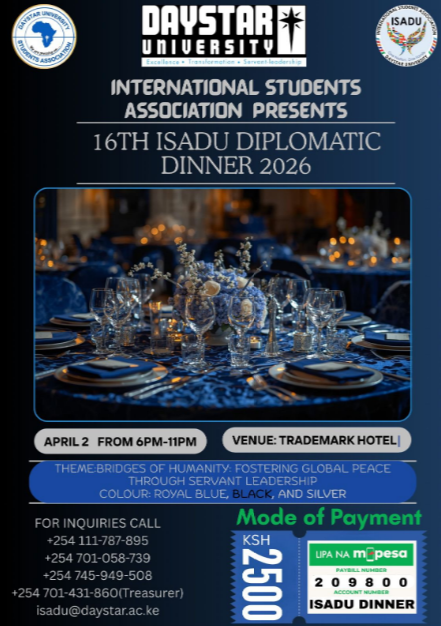
    Daystar University’s International Students Association (ISADU) is set to host the 16th Diplomatic Dinner on April 2, 2026, at the Trademark Hotel from 6:00 p.m. to 11:00 p.m.

    The event is open to students, faculty, and staff, positioning it among the most anticipated gatherings on the university calendar.

    Under the theme “Bridges of Humanity: Fostering Global Peace through Servant Leadership,” this year’s dinner aims to promote cultural engagement, meaningful dialogue, and the celebration of diversity. Attendees are encouraged to observe the elegant dress code of royal blue, black, and silver to match the sophistication of the evening.

    Over the years, the Diplomatic Dinner has become a flagship event for Daystar’s international community, providing a platform for cross-cultural interaction, exchange of ideas, and relationship building beyond the classroom.

    Organizers note that the event continues to reflect the university’s core values of Excellence, Transformation, and Servant Leadership while strengthening global awareness among students.

    Registration is currently ongoing through ISADU’s official communication channels. The 16th Diplomatic Dinner is expected to deliver an evening of culture, dialogue, and celebration as Daystar continues to position itself as a hub of global unity.

  • DAYSTAR STUDENTS SET FOR FINANCIAL LITERACY FORUM

    DAYSTAR STUDENTS SET FOR FINANCIAL LITERACY FORUM

    By Tracy Kavai,

    Daystar University is set to host a Financial Literacy Forum organized by the Daystar University Students Association (DUSA) on Wednesday, March 4, 2026. The event will take place at the Main Campus Amphitheatre from 10:00 a.m. to 4:00 p.m.

    Under the theme “Money, Freedom and Choices,” the forum will bring together experts from the Institute of Certified Public Accountants of Kenya (ICPAK), the National Treasury, and ICEA Lion Group. The session aims to equip students with practical knowledge on budgeting, saving, and investing, enabling them to make informed financial decisions in a dynamic economic environment.

    DUSA Treasurer Purity Wangui, who signed the announcement, underscored the forum’s significance, noting that the initiative seeks to empower students with essential financial management skills alongside their academic training.

    In addition to the learning sessions, participants will receive refreshments, free Red Bull cans, and transport for students traveling from the Valley Road campus. The event is supported by the School of Business & Economics, ICPAK, ICEA Lion, Red Bull, and Shelev X3.

    The Financial Literacy Forum is expected to draw strong student participation as the university continues to promote financial awareness and responsible money management among learners.