Category: Features

  • “…Now I know better. I will read and verify before I share”

    “…Now I know better. I will read and verify before I share”

    By Hellen Owuor

    hellenowuor10@gmail.com

    PHOTO: Hellen Owuor

    “ My life was consumed by fear and panic for the better part of 2020. I was constantly on my phone reading messages and watching videos on Facebook or WhatsApp about COVID-19 and how people are randomly collapsing on the streets and dead bodies everywhere. Sadly, I now realize that this information fueled my fear yet most of it was false,” Nina says as she strokes her kitten back and forth. “To a point, it affected my relationship with some of my friends and family because I didn’t want to visit anyone nor to be visited,” she adds.

    Amid the confusion and trying to grasp any information available about COVID-19, many fell victim to misinformation with some believing in the existence of the virus and others not. For example, on one extreme some people believed that COVID-19 does not exist, or that it doesn’t affect Africans. As a result, they ignored directives from the government and other entities such as the World Health Organization urging them to take protective measures. On the other extreme, some chose to believe myths such as COVID-19 is caused by simply talking to an infected person, therefore, locking themselves indoors. Ernestine says, “ A friend of mine bought 50kgs of rice which has now expired since he lives alone.” Panic buying was evident in Kenya having people stocking cereals, tissue rolls, sanitizers, and even drugs.

    The panic was fueled by misinformation on COVID-19 through videos, images, and texts that were constantly shared across social media intentionally or unintentionally. The root of misinformation is an individual or group that disseminates information intending to harm another group resulting in a political, social, or economical gain. These individuals prey on innocent social media users thirsting for information to help spread misinformation. This is seen in the case of COVID-19 where many believed, shared, and acted based on misinformation received.

    Apart from Kenyan citizens, the Government of Kenya has also fallen victim to the COVID-19 infodemic. Misinformation has poked holes in the trust some Kenyans once had in their government slowing down the efforts of the Ministry of Health and Health Practitioners to administer the COVID-19 vaccines and eradicate the virus. In 2021 when it is expected that everyone would be running for the vaccine, some Kenyans are still hesitant on getting the jabs. As of June 10, 2021, Kenya was ranked at number 25 out of 48 countries in Africa having 1.97 COVID-19 vaccine doses administered per 100 people compared to Seychelles with the highest in Africa at 139.51 vaccine doses per 100 people (Statista). At the continental level, by June 17, 2021, Africa had the second-lowest number of COVID-19 doses administered out of six continents

    Through interactions with some citizens, it is clear that some took the vaccines because of circumstances and not out of their own will. When asked to talk about how they feel about vaccination and the government’s conduct, this is what some Kenyans had to say.

    Below are some of the misleading information that has led to the friction between the government and its people:

    In February 2020, a plane from China carrying 239 passengers landed in Kenya, when most countries affected by COVID-19 at the time had closed their borders. This act led to an uproar among Kenyans, coming at a time when China accounted for the bulk of COVID-19 cases. At the time, some messages were circulating on WhatsApp, Facebook, and Twitter falsely claiming that COVID-19 was created in a lab in China. The lengthy message was posted on Twitter by Aly Khan Satchu, a verified user, giving the content more visibility and reach.

    In January 2021, a photo of boxes labeled ‘Remdesivir for Injection’ which has a list of African countries marked as ‘Not for distribution in the US, CANADA or EU’ showed up on social media and gained traction. This was around the time that several studies on the efficacy of redeliver in reducing the severity of COVID-19 infection. The misleading post was shared on FacebookTwitter, and WhatsApp, with some posts claiming that the drug was meant to wipe out Africans. This information was debunked by Piga Firimbi, an online fact-checking site, which indicated that the drug was not a COVID-19 vaccine. This was also confirmed on a Twitter post by Cipla, the manufacturer of the drug shown in the photo.

    In May 2021, another misleading message that was widely shared on WhatsApp claimed that Luc Montagnier, a French virologist, had stated that those who have received the Covid-19 vaccine would die within 2 years. A link attached to this WhatsApp post refuted the claims that Luc Montagnier made such a statement through an article on (Life Site News). 

    It is difficult to decipher whether a well-crafted sensational message is false if one does not have the skills. Nina says, “I innocently shared information not knowing it was false. I was not even aware that people can take their time to try and manipulate others through such sensitive information. At least now I know better. I will read and verify before I share.” 

    Just like Nina, other Kenyans are also contributing to misinformation about COVID-19. This is a call to you who is reading this: Be different. For whatever information you read, hear or watch, first, verify it then decide if it is worth sharing. Some tips on how to verify information include consulting professionals on the subject matter, following and consulting fact-checking sites like Piga Firimbi and Pesa Check, and attending training on how to identify false information. One step at a time will take us a long way in saving the lives and health of our citizens by eradicating misinformation about COVID-19.

    This publication was produced as part of IWPR’s Africa Resilience Network (ARN) program, administered in partnership with the Centre for Information Resilience (CIR), the International Centre for Investigative Reporting (ICIR), and Africa Uncensored. For more information on ARN, please visit the ARN site.

  • INVOLVEMENT ISSUE 240

    INVOLVEMENT ISSUE 240

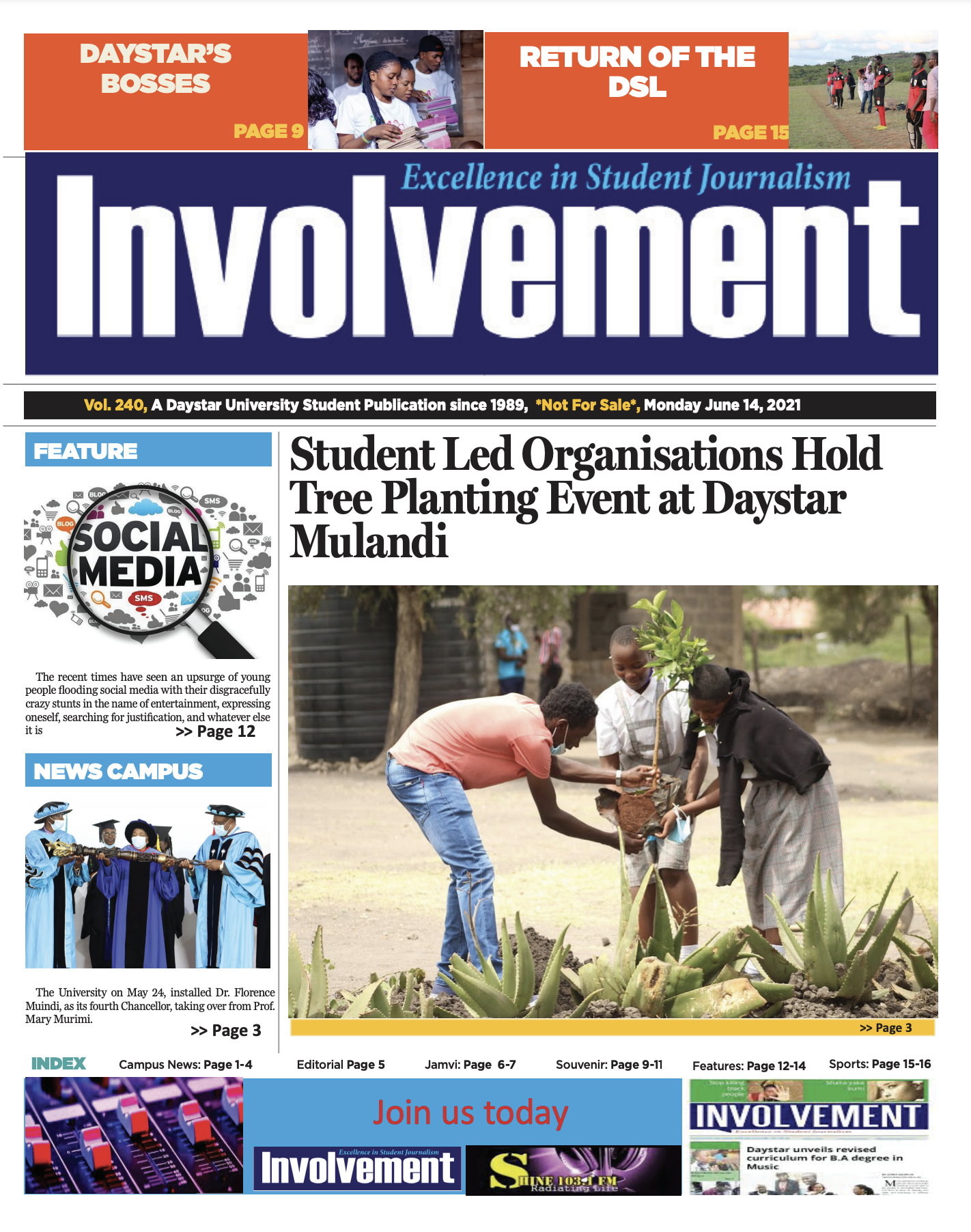
    Use the link below to access the Involvement Newspaper issue 240 which features a range of articles written by our writers to ensure that you stay informed on News within and outside Daystar. 

    Issue 240 Final


  • PERPETUALLY BEATING

    PERPETUALLY BEATING


    By Wangui Njau.
    (njaucatherine@gmail.com)

    Thumbnail Photo Courtesy of fineartamerica.com/

    Leaden is the heart.
    The heart sees the marvel in people,
    The heart refuses to give up on mankind,
    The heart that chooses to forget past wrongs,
    The heart chooses to love back.

    Leaden is the heart,
    The heart that loves even when not,
    For love bores no ill-will
    Even when wronged
    The heart chooses to love back.

    Heavy is the heart,
    Damning heart,
    I want you to always smile,
    Be fulfilled
    The heart chooses to love back.

    Leaden is my heart.
    The love given,
    Never received
    But in abundance it gives,
    For the world needs a little bit and a little more
    The heart always chooses to love back.

    The heart is what humanizes us. Being closed off to people, thinking that it makes you stronger, it makes you incapable. Because you will always be limiting yourself, you will always be holding back or holding out. There is ardour in sentiments.

    The same passion that brings forth growth in us, also brings innovation and bares creation. The heart allows us to commune, to love and be loved, to appreciate the things most precious in and to us.


    This doesn’t mean it has no risk; I’d be a charlatan if I told you otherwise. However, in order to love who you are, you cannot hate the experiences that shaped you.

    Therefore, you have to hurt in order to know, you have to fall in order to grow, lose in order to gain, because most of life’s lessons are learned in pain and only through embracing these experiences do we make peace with our hearts.

  • Mombasa on high alert as 3 test positive for Indian Variant

    Mombasa on high alert as 3 test positive for Indian Variant

    by Catherine Njau

    (njaucatherine3@gmail.com)

    Mombasa Public Health Chief Officer Pauline Oginga and Woman Rep Asha Mohammed receive equipment for fighting COVID-19 from Pathfinder County Director Solomon Omariba. Photo/ Laban Walloga.

    Mombasa County is on high alert after three people tested positive for the highly infectious Indian variant of Covid-19. This comes after the Ministry of Health (MOH) reported the first case of the Indian variant on May 5, days after it was detected in neighboring Uganda.

    In Mombasa, the two of the three patients who tested positive had arrived in the country between April 18 and 19, through Jomo Kenyatta International Airport in Nairobi. They later travelled to Mombasa by road, however, it has remained unclear how they managed to arrive in Mombasa.

    A presidential directive was in place, barring movement out of and into Nairobi at the time. One of the patients is a Kenyan to have travelled to India to attend to a patient and returned on April 18; the other is an Indian national who works in Kenya and arrived on April 19.

    Mombasa County’s public health chief officer Pauline Oginga, spoke to the Star saying “The two started manifesting symptoms days after arriving. They were placed in isolation as samples were taken to Kemri in Kilifi for testing and obtained positive results for the Indian variant.”

    Oginga said when the two arrived in Kenya, their results were negative but a few days later they developed symptoms and got tested again. She said the surveillance team has intensified tracing of those who interacted with them and also those who interacted with their contacts.

    The third case was from an individual who had travelled with a sick patient to Mombasa and later developed symptoms. As another case has also been reported in Samburu village, Kwale County. Ms Pauline Oginga said they were working closely with the national government to ensure contact tracing is done for all the passengers who arrived with the two patients.

    Upon the detection of the B.1.617 variant from India, the health ministry’s director general, Dr Patrick Amoth said, “This variant has been picked (up) in Kenya and because of global connectivity; it is just a question of time. You cannot be able to put barriers … to prevent a virus from accessing your territory.

    The case was detected among samples taken from Indian travellers who were working in Kisumu, a city in western Kenya, he added. No further details were provided. The World Health Organization (WHO) has said the B.1.617 variant of Covid-19, which was first found in India, has now been reported in more than a dozen countries.

    According to the Africa Centres for Disease Control, 20 countries are currently reporting the B.1.1.7 variant of coronavirus that was first detected in the United Kingdom in September 2020.

    The countries are Algeria, Angola, Cape Verde, Côte d’Ivoire, DR Congo, Equatorial Guinea, Gambia, Ghana, Gabon, Kenya, Libya, Malawi, Mauritius, Morocco, Nigeria, Rwanda, Senegal, South Africa, Togo and Tunisia.

  • A or 400-mark Score: Not A Ticket to Success.


    By Evelyne Syombua
    (Issyombua@gmail.com)


    Thumbnail Photo Courtesy of standardmedia.co.ke

    Just like the previous cases over the years, the announcement of the KCSE results on the 10th of May was crowned with joy, sadness, and celebration. As usual the top performing students and the top performing schools were listed .

    But why only celebrate the A students and those who scored above C+? Why list the top-performing schools and the poor-performing ones? And what are we doing about the latter?


    Well, for the longest time, good grades have been an honor to all students, parents, and teachers. The top scorers have become the country’s obsession and pride.


    Since the establishment of the 8:4:4 system, every year after the release of KCPE and KCSE results, the media space has been used to discuss the top students, top schools, the number of A’s, those who qualified for university, and the list is endless.


    Meanwhile, as best performers are applauded , the silent group of those who scored below C+ are forgotten and left feeling disoriented and less appreciated.


    Out of the 747,161 students who sat the 2020 KCSE exam, only 143,000 students scored a C+ and above. In a culture that prizes good grades over everything else, over 600,000 students would be considered “failures “.


    As students, teachers, parents, and the entire country, we have been made to believe the lie that the foundation to a successful life is in scoring above a C+. Yet the truth is it takes more than a “good grade “.

    This notion that only the academically gifted are the ones that will succeed in life has and continues to damage thousands of young Kenyans who, despite their best efforts, are still not considered worthy because of their ‘poor performance’.


    Do not get me wrong, I am firm believer that hard work should be rewarded. Awarding the best performers such as those who score good grades in certain subjects with badges among other forms of awards in school, gives them a feeling of recognition and appreciation.


    However, we must also actively think about the other learners who give their best yet do not manage to the pass mark stipulated considering their gifts, circumstances, and resources. As teachers and parents we compare our learners to those who are academically gifted with statements like “Why did you not perform like so and so? If only you could be doing what so and so does then you could score a good marks or better than her”. Without realizing it does more emotional damage than physical.


    For instance, when the pandemic struck the country early last year, not all learners could access the virtual learning platforms hence disadvantaging them over those who easily accessed these platforms. Likewise, not all students are academically gifted therefore scoring a D or an E should not be a measure of a learner’s intelligence.


    The truth is not all successful people got good grades let alone finishing their studies. Therefore as we acknowledge the importance of good academic performance, we should also not forget that in the current society, there is more to success than having a “good grade”.


    Let us shift our focus beyond school life, what kind of individuals do these learners become. What values did they pick up along the way? Did they become more compassionate and empathetic individuals? Did they discover their talents and gifts along the way? Did they sharpen their leadership skills?


    To quote Dr. Trish Hatch, “ What if we moved away from a single test supposed to determine one’s future college/career options and embraced self-awareness and self-assessment, career exploration, goal setting, and action planning instead? What if we exposed students to as many career options as possible and move away from the ‘known’ limiting careers? Aren’t all careers important for the well-being of society? “


    Most of the students end up stigmatized when looked at as failures simply because of their poor performance. And it gets worse when they do not end up in careers that society has branded important. This is one of the contributions of a large number of criminals and laggards who consider themselves as society rejects and life’s failures.


    It is time we accepted that not all students are academically gifted and disabuse ourselves of this culture where we use an individual’s ‘D’ grade against them in the future. Statements like ‘She/he cannot do the job because she/he is a D student’ or “we cannot hire you because of your D grade “ need to be eroded, because they only add to the already exploded problem.


    The country stands to gain a lot economically when it promotes career diversity by allowing students to choose professions matching their interests, skills, and abilities. Because each one of us has something to offer academic qualifications notwithstanding.

    It is prudent that as a country we rethink our definition of a “successful student”.

  • CDC eases mask-wearing guidelines for fully vaccinated

    by Sumaya Hussein

    (husseinsumaya1@gmail.com)

    A commuter receives a free vaccine at the Coney Island Station in Brooklyn – Photo/The Guardian

    The director of the Centre for Disease Control and Prevention (CDC) on Thursday said that fully vaccinated Americans can now participate in most outdoor activities, without wearing a mask or social distancing.

    The CDC head, Rochelle Walensky, revealed the agency’s new mask guidance during a White House briefing on coronavirus.

    “Anyone who is fully vaccinated can participate in indoor and outdoor activities, large or small, without wearing a mask or physical distancing. If you are fully vaccinated, you can start doing the things that you had stopped doing because of the pandemic.”

    However, fully vaccinated people are still required to wear their masks while using public transport including buses, trains ad airplanes. Walensky said that the CDC is continuing to review its travel policies, but did not explain reasoning behind Thursday’s announcement.

    “Right now for travel we are asking people to continue to wear their masks,” she said.

    Moreover, the CDC noted that vaccinated people should continue following the existing state, local or tribal laws and regulations on masks and social distancing, as well as policies at businesses and workplaces.

    Consequently, as of Friday morning, the rules looked very different from one state, city or county to the next.

    US President Joe Biden heralded the CDC’s announcement in an outdoor press conference hours later saying, “The CDC is saying, they have concluded that fully vaccinated people are at a very, very, low risk of getting Covid-19. Therefore, if you are fully vaccinated, you no longer need to wear a mask,” said Biden. “Let me repeat: if you are fully vaccinated, you no longer need to wear a mask.”

    Walensky also said: “We have all longed for this moment when we can get back to some sense of normalcy. Based on the continuing downward trajectory of cases, the scientific data on the performance of our vaccines and our understanding of how the virus spreads, that moment has come for those who are fully vaccinated.”

    To some, the announcement is a significant step in resuming pre-covid life, but others remain skeptical about the decision to ease the restrictions.

    Jeniffer Nuzzo, an epidemiologist at the Johns Hopkins Bloomberg School of Public Health said she expects mask-wearing to continue in transportation settings, as well as some other places open to the public, such as grocery stores.

    “I really don’t expect public settings to change that much until case numbers come down,” said Nuzzo.

  • Man found dead inside parked car in Kisumu

    By Aloise Munene

    (aloisestevest@gmail.com)

    Vehicle in which the man was found – Photo/ Citizen Digital

    Police officers in Kisumu are investigating the mysterious death of a 33-year-old man whose body was found on Wednesday in a stationary vehicle outside a petrol station in the Otonglo area of Kisumu.

    A security guard manning the station noticed a suspicious vehicle that seemed to have been oddly abandoned at the side of the Kisumu-Kisian road for a long period. According to the witness report recorded by Vincent Odongo, the security guard, the man was lying unconscious on his left side across from the driver’s seat to the front passenger’s seat. He raised alarm upon his discovery.

    The vehicle, a white Toyota Vitz registered KCW 646J, showed no signs of forced entry by a second party as the police found it locked when they arrived at the scene.

    The man, who was later identified as Habel Oile, was confirmed dead by detectives who broke into the vehicle.

    Preliminary investigations reveal that the car was seen parking the previous night, but the guards on duty do not recall seeing anyone alighting or boarding it.

    According to the County Police Commissioner Samuel Anampiu, the death is currently being treated as a suicide. The case’s direction was influenced by the investigation’s inability to determine whether other occupants had been in the vehicle and the discovery of a 25mm empty insecticide bottle inside the vehicle’s glove compartment.

    The body was taken to Kisumu Referral Hospital’s mortuary for post-mortem analysis.

  • WHO classifies India variant as ‘global concern’

    By Rozanne Nthambi.

    (rozannenthambi37@gmail.com)

    A Covid-19 patient rests inside a banquet hall temporarily converted into a Covid care centre in New Delhi – AFP

    The World Health Organization (WHO) on Monday classified the Coronavirus variant first found in India, as a global “variant of concern”. The organization said studies of the variant known as B.1.617, show that it may be more transmissible than others.

    Maria Van Kerkhove, the technical lead for Covid-19 in the WHO said that the variant may also be able to evade some of the protections provided by vaccines. The shots, however, are still considered effective.

    “And as such, we are classifying this as a variant of concern at the global level,” said Maria in a press conference. “Even though there is increased transmissibly demonstrated by some preliminary studies, we need much more information about this variant in this lineage, in all of the sub lineages, so we need more sequencing, targeted sequencing to be done.”

    According to WHO, a variant can be labeled as “of concern” if it has been shown to be more contagious, more deadly or more resistant to current vaccines and treatments.

    The group however issued a clarification to their earlier remarks to state that Covid-19 vaccines “remain effective at preventing disease and death in people infected with this variant.”

    WHO Director General Tedros Adhanom attends a press conference on July 3, 2020 – CNBC

    India is in a critical place as the country is recording hundreds of thousands of new cases each day, with more than 366,000 cases reported on Monday alone. Moreover, the country is averaging about 3,879 Covid deaths per day, according to data compiled by John Hopkins University.

    WHO says the variant has already spread to more than 30 countries including the US, UK, France and Japan.

    The surge in India rose rapidly last month, overwhelming hospitals of the harders hit cities in the country.

    “This is unlike the first wave. And so I think what we’re seeing is more transmissible,” said Soumya Swaminsthan, Chief Scientist at WHO.

    The Wall Street Journal released reports saying that only 2% of India’s population have been vaccinated, out of a population of 1.4 billion people, making the country largely vulnerable.

    The WHO however does not recomment border closures, saying countries should take a nuanced assessment before imposing restrictions and disruptions to global travel.

  • Netflix prices to increase in Kenya over inclusion of VAT charge

    by Sumaya Hussein

    (husseinsumaya1@gmail.com)

    The Netflix interface on a flat screen – Photo/ Business Today

    Netflix monthly charges have increased after the company included a value added tax (VAT) charge in its billing.

    The subscription service has reviewed its rates to Ksh1,100 from Ksh950 for the standard package and Ksh1,450 from Ksh1,200 for the premium package. The new prices are set to take effect from end of May.

    “Starting May 30, a value added tax (VAT) will be included in your Netflix price,” read the company’s message to subscribers.

    Subscribers under the basic plan that goes for Ksh700 will however not be affected.

    The increasing cost of the service has been slowly pushing people out of Netflix, which some now consider a luxury.

    The Digital Service Tax (DST) came into force on January 1 and was introduced to both the Income Tax Act (ITA) and Value Added Tax Act (VAT). Both Acts prescribe that DST shall be payable by a person whose income is earned in Kenya from the provision of services through a digital market place.

    The VAT applies to supplies undertaken in the digital marketplace at the standard rate when supplied in Kenya.

    Under the ITA, businesses selling services online are expected to pay a flat tax of 1.5 per cent on the value of goods supplied and sold online, or services offered through digital platforms.

    Services and goods that fall under the ITA bracket include e-books, movies, music, games, tickets for live events and theatres and subscription-based media including news, magazines and digital content.

    Online businesses have become a target for government to widen its tax base, with the aim of lifting domestic tax revenues. The Kenya Revenue Authority (KRA) is targeting businesses and persons under the new digital taxes selling services and goods online.

    The taxman is banking on the Covid-19 disruptions that accelerated the use of online platforms to sell goods and services, and raise Ksh5 billion from the sector in the six months to June.

    The latest data from the Communications Authority (CA) shows that mobile data subscriptions in Kenya stood at 44.4 million in the second quarter of 2020.

    Factors driving the growth include increased population coverage of 3G and 4G networks, availability of affordable smartphones and data plans. Moreover, the increased consumption of e-commerce, e-government, social media and other online content have also contributed to the growth.

    Why digital taxes?

    The KRA previously stated in Techpoint Africa’s previous report that digital companies like Google and Facebook generate a lot of revenue from Kenya but do not pay taxes. On top of that, several businesses in and out of Kenya, do not remit VAT for their transactions.

    Online businesses usually have no physical structures or addresses from which they operate, making it easy to escape taxations.

    The argument for taxing the digital economy is the same in most countries of the world – digital companies defy today’s tax laws and international trade agreements.

    However, it is difficult to determine where value is being created for digital companies Netflix, for instance, has engineers in the US and partners with video production houses all over the world. Where then are Netflix’s services being produced?

  • New Dawn for students as council takes oath

    New Dawn for students as council takes oath

    By Muhanguzi Tola

    tolakofa1@gmail.com

    Mrs Jane Irungu dedicates the DUSA student council 2021-2022 to God. PHOTO| Daystar University

    The newly elected council was on April 20 sworn in, to place them in the saddle of power, and usher in a new era for the student body.

    Team forward, as it’s known, is tasked with leading the students’ association and ensure that the recently launched strategic plan positively impacts students. The Marco Laboso led team has big shoes to fill- it’s predecessor having  successfully initiated a new dawn that brought with it Prof. Laban Ayiro. It is an undisputable fact that the team ascends to the helm of the association during a tough period of time, but with the right mindset and policies, can achieve great heights.

    The president, Marco, assured students of his readiness to serve them, promising to do so diligently. This is vital for a university that has experienced a vacuum in student leadership, due to tensions, changes and a severe pandemic. As the students’ leader, he will oversee the day-to-day operations of the council, and represent the interests of the association at the senate.

    Daystar is an institution anchored on a history of servant leadership- as the VC has continuously shown. Students should be at the center of this government. Top in the priority list should be to promote their spiritual, intellectual and physical growth through the power bestowed unto you by the congress. Instill a culture of unity among students, and come up with ways that will push them to achieve self- actualization.

    Echoing novelist Ken Kesey, you don’t lead by telling people some place to go. You lead by going to that place and making a case.

    The new government has to make a clean break with the past, and work on leaving a mark through good leadership and innovative ideas. We have an opportunity to craft a future of hope and progress. However, this will only be achieved through courageous leadership, and the ability to actualise new, bold ideas. As you take your seat on the high table, bring with you unique ideas and a sense of individuality to foster development agendas for the association.