Blog

  • THE DIAMOND VS THE NOTORIOUS: WHO WILL WIN THE TRILOGY?

    THE DIAMOND VS THE NOTORIOUS: WHO WILL WIN THE TRILOGY?

    BY KEN ANDREW

    kenakikenyi@gmail.com

    Thumbnail Photo Courtesy Of Instagram/Dustin Poirier)

    A turning point in the world of Mixed Martial Arts (MMA) is expected on July 10th* 2021 as “The Notorious” Conor McGregor will step into the octagon to face “The Diamond” Dustin Poirier for a third time in the Ultimate Fighting Championship (UFC). This fight is viewed as a do or die for McGregor as many feel that he may have to retire if he loses. 

    The Irishman has been vocal on social media throughout the pandemic often tweeting that he would like to challenge for both the UFC’s lightweight and welterweight titles. He held the lightweight title in 2016 after a spectacular second-round finish over former champion Eddie Alvarez but is yet to taste welterweight glory. Ever since his debut in 2007, McGregor has risen to become one of the biggest athletes in the world and has seen his wealth grow incredibly. He will be under pressure as Poirier looks to knock him out in consecutive bouts.

    In their first bout, which was in the UFC’s featherweight division, Conor got into Dustin’s head with mind games and trash talk. The Irishman knocked Dustin out and was then seen as a serious contender for a title. This was at UFC 178 in 2014. Fast-forwarding to January 2021, both men were competing in the lightweight division and met in the octagon for the second time headlining UFC 257 in Abu Dhabi. The first round was pretty even with Dustin landing some good low kicks and taking Conor down while Conor landed some good left hands and shoulder strikes. In the second round, a flurry of punches from Dustin saw him knock out Conor, something nobody had seen coming. As sweet as the victory was, Dustin was quick to acknowledge that they were tied 1-1 and a third tiebreaking fight had to happen. The third fight was then set for UFC 264 on July 10th, 2021 in Las Vegas, Nevada. It is expected to be the biggest Pay Per View (PPV) of the year. Unsurprisingly, the tickets for the event were sold out in seconds!

    McGregor (left) and Poirier fight at UFC 257 in Abu Dhabi Photo Courtesy Of Getty Images)

    The pair have had words for each other on social media with Dustin disappointed that Conor did not honor his promise to donate half a million dollars to his charity and Conor angrily retorting that it was meant to be “a donation, not a debt”. This sets up the fight nicely with everyone involved expectant to see the Conor of old with his swagger and brilliant trash talking which has not been seen in his last two fights. This winner of this fight will get the next shot at the lightweight title which is currently held by Jiu-Jitsu specialist Charles “do Bronx” Oliveira.

    One of the big questions still yet to be answered is centered on Conor’s motivation. He was recently named the highest-earning athlete by Forbes having earned $180 million in 2020, surpassing even footballers Cristiano Ronaldo and Lionel Messi! Marvin Hagler, a boxing legend, once said that it is hard to get up in the morning for a run when you are sleeping in silk sheets implying that it is hard to find the motivation to go to work when you have already earned everything you may want- money and titles for example. Conor has won two titles in the UFC; he recently sold his whiskey brand for a huge amount and has a couple of endorsement deals. Why does he still keep fighting? Do these factors affect his preparations for fights? If there was a time to put the doubters and those questioning his motivation away for Conor, it is on July 10th.

    Whatever the outcome, the fight promises to be exciting. Will Dustin put Conor away or will Conor put his best foot forward and deliver another iconic knockout. We will find out on July 10th as The Diamond Dustin Poirier takes on The Notorious Conor McGregor in the biggest fight of the year.

    *July 10th is the official date provided by the UFC. Due to time zone differences, the event happens on July 11th EAT in Kenya.

  • Thieves posing as Daystar students steal two bikes from businessman

    by Sumaya Hussein

    (husseinsumaya1@gmail.com)

    Student entrepreneur Noah Karuri at his bike station few meters from Daystar University, Athi River – PHOTO/Denis Mavia

    Two men stole two mountain bikes from a student with a bike hiring business using a lost student ID that belonged to another Daystar student. The two men hired bikes from Noah Karuri, the business owner, on May 25, never to be seen again.

    According to Karuri, the men looked like students and one of them resembled the picture in the student ID, which was handed over before taking the bikes as per the regulations. The two also left their mobile numbers, one a Safaricom and the other an Airtel number, before taking off at around 3pm.

    “They were new clients. I had not seen them around, so I thought they were freshmen. When they came to hire the bikes, they asked me about the requirements and I told them they had to leave their IDs, either national or student ID, and their phone numbers too,” said Karuri

    According to Karuri, the two men did not specify where they were going and how long they would take. Since they said they were headed to Mombasa Road, Karuri decided to call and check in on them after two hours. He dialed the Airtel number for the first time at around 5pm and the owner picked, saying the two were on their way back.

    “After one hour again, I called them at around six. They said they’re almost at Lukenya Getaway. But at that point I felt suspicious,” said Karuri.

    In a state of panic, Karuri took a bike to Lukenya Getaway to try and locate the men but did not see them. He went further up to Lukenya Boys High School and the result was the same. He called again at around 6:30pm, but this time, the number did not go through.

    “It was off. I couldn’t believe it,” said Karuri. “I chose to think that maybe their phone went off or something came up and they’re still coming,”

    After closing the business for the day, Karuri in the company of a friend, cycled to Mombasa Road in search of the bikes.
    “We cycled all the way to Green Park then to Devki, and we came back at around eight. We didn’t see anyone,” said Karuri.

    Going back to his records, Karuri was shocked yet again when he discovered that the other number left behind was incomplete. It had one less digit and this led him to think that the disappearance was planned.
    “It was strategic. So I was sure that something had really happened,” said Karuri.

    The following day, Karuri reported to the matter to the police, who asked him to first confirm with the university whether the student ID left behind was still valid.

    After following up on the matter, Karuri learnt that the ID belonged to a student, who misplaced it in early 2020 and replaced it two weeks later. Speaking to Involvement, the third-year Valley Road student said that he lost the ID when his wallet was stolen in Nairobi West. The student who goes by the name Trevor alone, also mentioned that he has never been to the Athi River Campus.

    After checking back with the police, Karuri learnt that the new information further complicated the mystery. He was told that there was not much that could be done since the ID used was fake and the Airtel number would be hard to trace.

    Being the first time it has happened, Karuri said that the loss affected him to a point that he couldn’t sleep or eat. He now lives in constant fear that his business might be targeted again.

    “I have had trauma every day,” said Karuri. “A lot of trauma. When someone leaves with a bike, I can’t help but wonder whether or not they will come back especially if it’s a new person”.

    The incident however, he says, has made him more vigilant and forced him to introduce stricter protocols in his business.

  • INVOLVEMENT ISSUE 240

    INVOLVEMENT ISSUE 240

    Use the link below to access the Involvement Newspaper issue 240 which features a range of articles written by our writers to ensure that you stay informed on News within and outside Daystar. 

    Issue 240 Final


  • Safari on the Rally

    By Jonah Karanja

    Rally car passes by as onlookers enjoy the scene. PHOTO: sportsnews.africa

    After nearly 19 year of inaction, the Safari Rally is back in action in the Kenyan Wilderness. The event is expected to unite young and old motorsports enthusiasts in cheering and enjoying the thrill that is created by sports cars while also enjoying the scenic beauty that lies across the six planned rally routes. The 3-day event is to mark the sixty eighth running of the Safari Rally and will be the sixth round of the 2021 World Rally Championship, World Rally Championship-2 which is the second tier in rallying event and World Rally Championship-3 which is the third tier in the event.

    The WRC Safari Rally return is much anticipated by Kenyans, event organizers, rally drivers and motorsports manufacturers among them Hyundai, Toyota, Ford and Volkswagen as they wait to test their modern vehicles on the unforgiving Kenyan terrain. The Kenyan government through the ministry of Sports, Culture and Heritage is giving the event and its organizers all the necessary support to see to it that the WRC Safari Rally has successful return. The smooth return of the WRC Safari Rally after a 19year break cements Kenya’s position when it comes to sporting events ranging from rugby, camel, athletics and motorsports. “We want to make Kenya the rally country in the continent and the entire globe,” Sports CS Amina said.

    Probably the biggest sporting event in Kenya, the Safari Rally was supposed to make a comeback in the WRC around July 2020 but was postponed due to the Covid-19 pandemic that is wreaking havoc across all sporting activities in the world. Nearly all sporting activities in the year 2019-2020 were cancelled or rescheduled as crowding was attributed to be a big factor in increased Covid-19 infections in Sports.

    Due to its rugged nature, Kenya’s  welcoming, and sporting spirit and unforgiving terrain, the Safari Rally reputation is set to increase tourism activities into the country hence bringing in the much needed foreign exchange into the Kenyan Economy.

    The 3-day WRC Safari Rally event is projected to inject approximately 6 billion into the Kenyan economy while also creating employment in the service industries such as caterers, local mechanics in the workshops and purchase of locally made products. The Made in Kenya brand and products will be visible to hundreds of foreigners and spectators especially through Media Coverage.

    By taking advantage of the World Rally Championship Viewership, Kenya as a country will be laid bare in the eyes of people hundreds of miles away given that the World Rally Championship commands a viewership of almost 800 million. With the ever-growing view ship, The Safari Rally is set to advertise Kenya’s capability in event planning and hosting, Kenya’s welcoming people and Kenya’s progress in terms of social economic structures as a middle-income country, all which will impacts positively to our economy.

    The Safari Rally comes barely a month to the onset of the Great Wildebeest migration which is heralded as one of the seven new wonders of the world. It is indeed a great time to be in Kenya to witness the transition from Man versus Machine to Animals versus Nature. The migration is an annual spectacle in Kenya’s Maasai Mara and Tanzania’s Serengeti and boosts thousands of Animals that try to overcome tiredness, hungry crocodiles, lions, hyenas and wild dogs. The sports tourism and nature tourism will give Kenya an edge when it comes to Tourism in Africa and bring about development as part of the revenue earned can be used as a driver towards the realization of the Big 4 Agenda.

  • KORA:  The Grammy-award-winning African instrument.

    KORA: The Grammy-award-winning African instrument.

    By Hilmelda Tenkeu

    (hilmeldatenkeu@gmail.com)

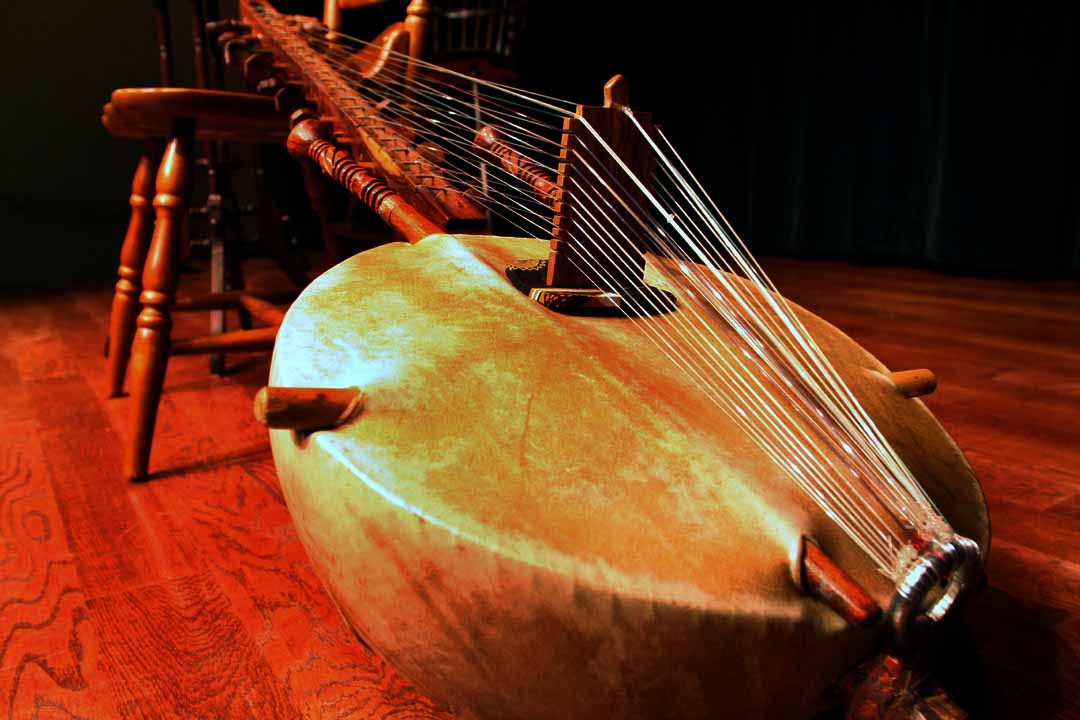
    Thumbnail Photo: the kora instrument Photo courtesy of theculturetrip.com

    Do you know the guitar, piano or saxophone? Of course you do. But do you know the Kora? Thought as much! The beauty in Africa’s diversity is reflected in the people, the food, the languages, the MUSIC, amongst other features. “Music is food for the soul”, so they say. But in the Mande territory, Music is a language. Ask Toumani Diabate, Sidiki Diabate, Sona Jobarteh, Mamadou Sidiki Diabate, or Tunde Jegede.

    The Mande territory, (commonly referred as Mandinka territory) is made up of countries of West Africa: Nigeria, Guinea Conakry, Gambia, Senegal, Ivory Coast, Benin, Burkina Faso, Ghana, Guinea-Bissau, Liberia, Mauritania, Niger, Sierra Leone and Mali. One common characteristic of these people is that they are griots. Griot or “Jali” (the Mandingo word for) is the repository musician and storyteller of Mande’s ancient oral tradition, transmitting history and culture from generation to generation, from father to son. “we are the custodians of history… the remembrance of West Africa”, says Toumani Diabate, a griot.

    I guess you have come across movies or songs in which fictitious characters or not, sit around a fire and listen to a story, told by an elder person- a griot. In the words of Toumani Diabate, usually referred to as the “king of kora”, “you are born a griot, you don’t become one”. Griots use various forms of art to tell their stories: poems, drawings, acts, spoken words and music. More specifically instruments, amongst which the Kora.

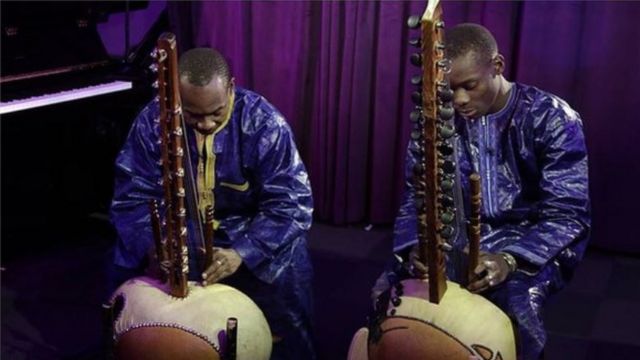
    Toumani and son, playing together. Photo courtesy of Djeliba24.com

    The origins of the instrument are not very clear but in the 1300s, the traveler Ibn Battuta mentioned that the women who accompanied Dugha (a prominent interpreter at the time) to perform were carrying bows that they plucked. He did not mention the number of strings, but this clearly shows the existence of harp instruments in 14th century Mali and could be the earliest written reference to the kora. The Kora is a string instrument used extensively in West Africa. It typically has 21 strings, which are played by plucking with the fingers (the thumb and index of each hand only). It is built from a large calabash, cut in half and covered with cow skin to make a resonator with a long hardwood neck.

    The skin is supported by two handles that run underneath it. Each string plays a different note, supported by a notched, double free-standing bridge. The kora doesn’t fit into any one category of musical instrument, but rather several, and must be classified as a “double-bridge-harp-lute.” Traditional koras feature 21 strings, eleven played by the left hand and ten by the right. Modern koras made in the Casamance region of southern Senegal sometimes feature additional bass strings, adding up to four strings to the traditional 21. The strings were authentically made from thin strips of hide, such as cow or antelope skin. Today, most strings are made from harp strings or nylon fishing line, sometimes plaited together to create thicker strings.

    Toumani and Sidiki performing. Photo courtesy of justinmorel.info.

    A vital accessory was the nyenmyemo, a leaf-shaped plate of tin or brass with wire loops threaded around the edge. Clamped to the bridge or the top end of the neck, it produced sympathetic sounds, serving as an amplifier since the sound carried well into the open air. In today’s environment, players usually prefer or need an electronic pickup. By moving the konso (a system of leather tuning rings) up and down the neck, a kora player can retune the instrument into one of four seven-note scales. These scales are close in tuning to western major, minor and Lydian modes. The Kora is regarded as the identification canon for the Mande people. Therefore, it is somewhat sacred. Formerly, in order to learn to play this instrument one would give 10 pieces of colanut plus 100 cowries. But these days, one pays 500 francs CFA plus 10 pieces of colanut.

    This is symbolic and it preserves the value and significance of the culture and history of the Mande people. The soulful and soothing sounds that the kora produces has made various players from the likes of Ali Farka Toure, Toumani Diabate to earn national and international recognition from all over the world such as Emmys, Grammys, BET and others. You can savor these pure works of art in titles like Jarabi, Cantelowes, Rachid Ouiguini, among others. The Diabate griot family have been doing music with the kora for over 71 generations.

    This shows and proves the attachment, value and respect that Africans in general and the Mande people in particular hold for culture and tradition.

  • Physical Exams To Be Adopted From May Semester

    By Aaron Kituku

    (kaykituku@gmail.com)

    The Vice-Chancellor Prof. Laban Ayiro announced during a chapel service at the main campus on Tuesday that all May semester exams will be done physically.

    “Exams will be done physically on campus, to ensure the quality and the integrity of exams,” said Prof. Ayiro in an interview. “We are in the process of acquiring the needed software which will guarantee the sanctity of exams.”

    The new directive will take effect from this semester where all students will be required to do their exams on campus. According to Prof. Ayiro, online instruction and learning will continue however final semester evaluations will from now on be done physically.

    For international students who had traveled back home, a special provision has been set whereby, stringent arrangements will be made for them to have exams in their specific countries through the Kenyan missions.

    “We will observe the (Covid-19) protocols. Students will come in shifts [and] the exams will be spread.” said Prof. Ayiro adding that Daystar is not constrained of space. All the rooms on both campuses, all the theatres including the amphitheater on the main campus, will be examination centers.

    “I also want to remind my students and the community that, this is what is being done by all public universities. You cannot risk the integrity of exams,” continued Prof. Ayiro.

  • Business man Chris Kirubi dies at 80

    By Evelyne Syombua

    (issyombua@gmail.com)

    The late Chris Kirubi – PHOTO/TheStandard

    Billionaire businessman Chris Kirubi, who was also the chairman of Capital Group Limited, died of cancer in his home on Monday at 1pm.

    “It is with great sadness that we announce the passing of Dr. Christopher J. Kirubi who passed away today at 1 pm at his home after a long battle with cancer fought with fortitude, grace and courage,” his family said in a statement, adding, “he was surrounded by his family.”

    Kirubi who has been fighting cancer since 2016, leaves behind two children. Before the call of death, he tweeted.

    “Top of the morning to you, my dear friend. It doesn’t have to be a tiring Monday. Instead, I bring to you good tidings of favour, success, achievements and happiness in the new week.” Said Kirubi. “Give yourself a go towards your success plan. Enjoy today and the rest of your week.”

    “I have received the shocking news of the passing away of my friend Chris Kirubi with a lot of sadness. The cruel hand of death has robbed our nation of a patriot whose entrepreneurial spirit, hard work and determination saw him create some of our county’s largest enterprises which offer employment to thousands of our people,” mourned President Kenyatta.

    Kirubi was diagnosed with colon cancer in November 2017 and he was taken to the US for treatment. At that time, he said the cancer was detected early enough to be managed successfully.

    In an interview with BDLife in January 2020, Kirubi shared about his battle with cancer and his thoughts on death.

    “One thing I have come to discover is that in the end, you’re alone. Your friends may love you, but eventually, you have to deal with your sickness personally. You think about the past, the things that you could have done, the things that you have not done and what you can do to compensate for things you ignored. It is a time of reflection. And prayers from friends do help a lot,” said Kirubi.

    Kirubi was a director of Centum Investment Company, one of the largest investors in the group. Business seems to have ran though his blood vessels as he was the chairman of DHL Express Kenya Limited, Haco Industries Kenya Limited, Kiruma International Limited, International House Limited, Nairobi Bottlers Limited, Sandvik East Africa Limited and 98.4 Capital FM.

    In addition, he was the Deputy Chairman of Bayer East Africa Limited and a non-executive director UAP Provincial Insurance Company Limited and Beverage Services of Kenya Limited.

    In 2011, Forbes ranked Kirubi as the second richest Kenyan and the 31st richest man in Africa with a net worth of USD300million. However, in 2012, he was dropped from the list of the continent’s 40 richest people.

    Kirubi was born in a poor family and at a young age. He worked during school holidays to support himself and his siblings after the death of his parents. He defied the rule of fate and circumstances by becoming prosperous despite his background.

  • Falcons Stunned as Daystar City Run with Derby

    By Muhanguzi Tola

    tolakofa1@gmail.com

    Daystar City’s Prince Kofi stole the show with a cameo performance as his second half hat trick sealed a 3-1 comeback in a mouthwatering derby played at the Mount Kenya University (MKU) grounds on June 13.

    Falcons looked on course to extend their good form following yesterday’s win when Emmanuel Lorenzo’s first half strike gave them the lead in the early morning fixture against their arch rivals. The former City player’s goal was however not enough, as his former team was full of responses in the second half.

    Insipid in the first, the City side returned for the second half livened up, Kofi taking advantage of two fumbles by the falcon’s keeper and a kick from the spot to punish the Athi based team. Brilliant performances by Eric Linox and Nathan Hanif, who won the penalty for his team fostered a hard-earned coveted victory.

    “It was a tough game, but I am proud of Daystar City. We conceded in the first half but rallied in the second and showed heart and desire to earn a comeback win. I loved our fight as a team,” said Ken Andrews, the Daystar City team captain.

    The win is their first of the season having lost two and drawn one. It also marks a comeback from yesterday’s game that saw them get thrashed 5-1 by log leaders Kenyatta University (KU), and takes the team off the bottom of the standings.

    Falcons on the other hand moves below City on the log for the first time this season, each having 4 points. City however have a game in hand over their rivals, having played a game lesser.

    The clash saw a number of intense moments, with City’s Kenneth Kagugo seeing red in the second half. The coaches were forced into making substitutions after Falcon’s sharpshooter Victor Atta ran into Nathan, both picking up injuries in the process.

    Atta’s injury adds on to Falcon’s crisis, with forward Gian Gaile having picked one during yesterday’s 2-0 FKF win against 3K FC. Head Coach Boniface Mutuku had hinted at the possibility of having a tough day, as he insisted on the importance of both teams’ recovery after yesterday’s matches.

    Falcons look to respond to the defeat when they face Al Ahly in their second game of the day.

  • IN 1000 WORDS

    IN 1000 WORDS

    By Nyokabi Ng’ang’a

    Leshnyokabi@gmail.com

    Thumbnail photo, courtesy of: Nyokabi Ng’ang’a

    Many who have crossed paths with me, will know one thing if not a multitude of things about me: and that is my passion about Africa. A passion that has been nurtured by many people I’ve met in my lifetime. And with this article, I’ll share some of my aspirations and observances about the African continent and its inhabitants, in a twisted way.

    Today, unlike the many days of my article writing, I won’t put much hard-inked references, if any, within this piece. As I stated and to further reinforce, this is more of an observatory or analytical piece that stems from the deepest veins of my soul.

    Africa! The word itself seems recital given how much it’s used by many a people from different nations, ethnic groups, professions etc. If we were to pen down the most used words in our world today, I dare say, Africa would be one of them.

    There is no day, truthfully speaking, that goes without we mentioning the word Africa. And by ‘we’ I mean us all as inhabitants of this world. If it’s not about a war that occurred recently or a coup that took place instantaneously, then it could be about the target location of our business premises or its prospects, or even, a corruption scandal that has been unearthed, and the narrative continues.

    But this doesn’t mean that Africa is the only continent in mention in our lips today. Many continents are and thanks to the flow of information, today we can appreciate other nations from other continental approaches and feel free to talk about their issues, histories and intricacies from a third person’s perspective. In a similar manner, we of the African descent are enabled and empowered to speak about issues facing us as a continent though with some ‘caution’ attached to it. By this I mean, some African nations opt to have them themselves pin point their own challenges as well as successes with no ‘outsider’s help’. I believe we can identify such audacious nations within our continent, without me mentioning them.

    However, worth the note, this spirit of enablement and empowerment has not touched all peoples of Africa, given the narratives of: marginalization and seclusion of some people and the divide-phenomenon evident in various sectors within our societies, such as: the digital divide; the economic divide, the geographical divide, the political divide and so on. Now, let us take a stroll to the most used phrase in Africa today: “We must unite as Africans.” Whenever I hear these words, I love to position to myself the following questions:

    • Why are we uniting?

    • Were we united back in the days?

    • What will we achieve by uniting?

    “Why are we uniting?” It’s quite obvious that people unite because of a common goal; a common purpose, which they would love to achieve.

    This I would love to believe is the same line of thought where Africa is concerned. We want to unite because- as captured in the words of the African Union (an organization I hope we haven’t lost belief in)- we want “an integrated, prosperous and peaceful Africa, driven by its own citizens and representing a dynamic force in the global arena.” That’s our goal, but I ask, what’s our incentive? Let’s go back to history. The history that declares the formation of our continent as ancient yet treasurable. Giving rightful praise to all the civilizations evident in our continent before the colonialists set foot in Africa, it’s quite ascertainable and worthy of rightful-historical positioning that before colonialism waved itself into Africa, Africans were interacting with one another- without the help of anyone. In Swahili, we would say: “Waafrika walikuwa wana(ki)tangamana…” and from my linguistic leaning, I feel this Swahili phrase captures the intensity of the words I want to position, for if it were in English, the word “tangamana” would be substituted for “mix”, which carries less weightiness, for me.

    Away from my linguistic leaning, what I am trying to position is that Africa was, before; before we came to know it was. In short, Africa was existing in its make, outlook, vibrancy, cultures, and oneness before we came to know that it was. “Before we came to know that it was” means before we came to the acknowledgement of the words: “Africa must unite.” The proliferation of the phrase, “We must unite as Africans,” to me, begun when African nations, through their people, were fighting for their independence. The urge and urgency to unite against colonialism and colonialists, became prevalent and necessary. To me, that is/was the incentive: “we are fighting against a common enemy: colonialism/colonialists.” That’s why I asked, earlier on: yes we are uniting, but what’s the incentive? Many answers can stream from this question, but I would love to have you answer this question by yourself. Moving on, “were we united back in the days?”.

    While it’s hard to establish how in exact we were united back in the days- pre-colonial times to be precise-, one thing for sure that we can’t erase is that there was a working relationship amongst the Inhabitants of Africa. A relationship that caused people to intermarry, to trade with one another, to pay homage to one another, to fight with each other and so on. This goes to show, the narrative of unity doesn’t only lie in the face of trouble. All these aforementioned acts show that we were in unity with one another. Though this doesn’t cover the whole narrative, given that tribes fought other tribes; kingdoms raided other kingdoms and so on, but it seeks to show, we didn’t need to have a common enemy for us to know that we needed to unite. Small acts of tribute that extended a welcoming hand from one tribe to another and from one kingdom to another, show that people in Africa were seeking harmonious living- where possible- with one another.

    Lastly, “what will we achieve by uniting?” For this question, I would love to leave it blank. Reason being, it’s a question that seems to have direct answers, such as: a great continental frontier, good working relations, strengthening of our economy and so on, but it requires- I tend to believe- more than a physical manifestation of this achievement. Though, all these achievements from our continental unity are truthful and certified, as such. It’s my understanding, that maybe I haven’t answered all the three questions wholly. However, onto a far-fetched thought, these three questions call for three things: understanding our present, understanding our past and understanding our future.

    “Why are we uniting” is a present question seeking for past references and now and future changes; “Were we united in the past” is a question of the past, seeking for inner retrospection of our past in its entirety and truthfulness; and “what will we achieve by uniting” is a forward moving question, which seeks to solve the present and the past into the future. In summary, understanding/defending/calling for the unification of Africa requires the past, the present and the future. Too obvious of an analogy, we might state. All in all, I believe I have established the foundation and because I intend this to be a personal and personable article to you, I will close in a poem that will share my aspirations, as well as observations of my continent in a tangled way, given the length- constraint this article has:

    IN 1000 WORDS

    In 1000 words, we sing your praises and call you a mother of all rights Africa,
    In 1000 words, we shower you with blessings and splash you with profanities oh Africa!

    In 1000 words, we call you and image you rightfully Africa,
    In 1000 words, we pray for you and cry for your freedom oh Africa!

    In 1000 words, we understand your history Africa,
    In 1000 words, we comprehend your inner mysteries oh Africa!

    In 1000 words, we stand with you to watch your reclaim Africa,
    In 1000 words, we desert you to have our bargain oh Africa!

    In 1000 words, we cry for your Independence Africa,
    In 1000 words, we tie you with restraints of all kinds oh Africa!

    In 1000 words, we hope for your return Africa,
    In 1000 words, you cry for our return oh Africa!

    In 1000 words, we purge you Africa,
    In 1000 words, you cry for yours and our consecration oh Africa!

    In 1000 words, we look up to your salvation Africa,
    In 1000 words you beseech your maker for a congregation oh Africa!

    In 1000 words, we wish you peace Africa,
    In 1000 words you seek for your inner calm oh Africa!

    In 1000 words, we write our sentiments Africa,
    In 1000 words, you write back in your inked-tears oh Africa!

    This poem carries with it my observations as well as my aspirations, if looked into keenly. Since length is an issue, my final words as a humbled Involvement writer are:

    “The reawakening we so wish to have as a continent, has already set foot. People, youths more so to this regard, have risen to the task of their calling, which is to defend their place of birth or rightful belonging. But as I love to position, there are challenges within that moving on, we will grapple with as we embark to the road of discovering the Africa we want, but that’s the fun of it.”

  • DERBY DAY FOR DAYSTAR FOOTBALL AS FALCONS TAKE ON CITY

    DERBY DAY FOR DAYSTAR FOOTBALL AS FALCONS TAKE ON CITY


    BY KEN ANDREW
    kenakikenyi@gmail.com

    Thumbnail Photo Courtesy of facebook.com


    The Daystar University sports department and football enthusiasts will on Sunday June 13 be treated to the biggest game of the season so far. The Daystar Falcons (The team based in Athi River) will play hosts to Daystar City (the team based in Valley Road) in the Daystar Derby. The match is a Kenya University Sports Association (KUSA) League match and will be played at Mount Kenya University in Thika- a neutral Venue.


    The Daystar derby is just like any other derby worldwide; it is a feisty clash with both teams eager to keep their pride intact and get bragging rights by beating their closest friends- who are also their fiercest rivals. The fact that the match will be played at a neutral venue takes a little bit of spice off it but expect a proper and intense showing by both teams.


    This will be the first KUSA League Daystar derby since early 2019. The last meeting was a friendly at the Bethel Grounds in Athi River with the Falcons getting a slim 2-1 victory. On Sunday, both teams will be under pressure to secure the three points as the league is beginning to pick up.

    Daystar City coach Antony Baki discusses Tactics with the team (photo retrieved from Sadiqsnapshots)

    Daystar City will be looking to capitalize on the fact that they have only played two games, drawing one and losing the other. They have a double header this weekend facing the table toppers Kenyatta University Main Campus on Saturday before engaging the Derby on Sunday. The Falcons, on the other hand, have played four games, drawing two and losing two.


    “I’m excited about the derby because it’s obvious, as has always been, that the Falcons will take it home. We’re prepared to do what we always do so Daystar City should just concede while they can,” said Millicent Tipatet, the Falcon’s team manager.


    The Falcons were boosted by the arrival of new players who were impressive in their debuts. Amongst them is Emmanuel Loreng’-who mostly goes by the name “Lorenzo”- who switched allegiances by leaving City for Falcons. He will be a key player alongside captain Barack and Gian. For Daystar City, new arrival Joss Chindia will be looking to make his league debut with regular Nathan Hanif keen to increase his goal tally for the team.


    When questioned about the derby, Daystar Falcons captain Barack said that both teams will be out to stop the other. He added that derby games have a special place in the hearts of fans and that it will be their chance to witness what the players have to offer. He reiterated, from a management point of view, that everything had been done to facilitate both teams. The views from many in the City camp is that they have been neglected with their equipment and kits being old and few. They have been unable to secure new ones for a very long time.


    Daystar City’s assistant captain Victor Gakuru said that he expects a tough outing in a rivalry that has stood for a longtime. The Nairobi Campus Secretary Brian ‘Zaza’ Achoka is expecting competitiveness in the fixture and added that a win will be important for Daystar City.

    His counterpart, Walter Nalwa, from Athi River says that his team has trained adequately throughout the week with the players being fit and ready to secure the points. He is hopeful and confident that the Falcons will win.


    With both teams out for the win, it is sure to be an enticing match.